On the Road Again Great Lakes States the Great Lakes States Names on Map
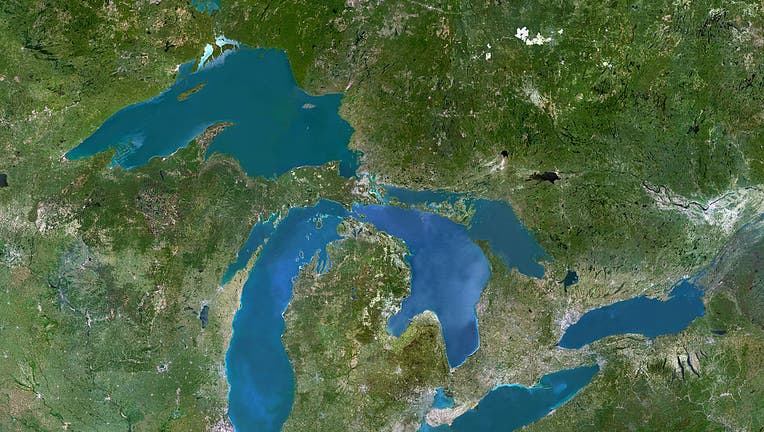
True colour satellite image of the Great Lakes region which includes the Canadian Province of Ontario and 8 U.s.a. states. Lakes are from west to east : Lake Superior, Lake Michigan, Lake Huron, Lake Erie and Lake Ontario. Composite image using LANDS
(Play tricks 2) - The Great Lakes may surround Michigan, but it'southward the region'due south ethnic and colonial history that surrounds the ways we know and identify them.
From Ypsilanti to Tecumseh, to Ottawa and Mississauga, the cities and towns and geographic features that dot the Michigan landscape are full of references from the past. Many of the names are derived from indigenous tribes and chiefs.
There's also evidence of Michigan's colonial history in the names nosotros use today. Detroit, for example, comes from the French term for "strait." But before the city had its name, information technology was the river that was first identified by its mutual term today.
"Le détroit du Lac Érié" or the strait of Lake Erie refers to the Detroit River that connects the Great Lake to Lake St. Clair and the h2o bodies further north and to the west.
The French also had a name for Lake Erie. Early writers referred to the water torso every bit a cat, or Lac Du Chat. Only the inspiration backside that name is likewise baked into the indigenous cultures that previously populated the area.
MORE: Dandy Lakes shipwreck hunters had a banner year in 2021 searching for remains of onetime vessels
Here'southward how the Great Lakes got their names:
Lake Superior
Largest in surface expanse, volume, and rich in natural resources, it's also famous for many shipwrecks including the sinking of the Edmund Fitzgerald, which was popularized in the Gordon Lightfoot song that honors the wreck.
The song's lyrics besides reference a verse form'due south phrasing of Gitche Gumee, which translates from an Ojibwe dialect referring to "big sea" or "huge water" or "corking lake." The Decolonial Atlas, a volunteer-run project that builds maps in relation to an area's indigenous heritage, says Gichigami directly translates to "sea" or "big liquid."
Lake Superior as well earned a French designation of lac supérieur, or "upper lake."
Lake Michigan
The origins behind Lake Michigan's proper noun are a flake less glamorous. The directly translation comes from an Ojibwe term of Mishigami, or "large lake" or "great water."
But the Michigan Department of Bang-up Lakes, Surroundings and Energy says before its common tongue stuck, it was first chosen Grand Lac by the French navigator Samuel de Champlain.
It was later named Lake of the Stinking H2o. The "stinking" name is possibly derived from the abundant algae that grows on parts of the lake.
It was also called Lake of the Puants after the nations that lived forth its shores. Puans were reported to exist the showtime ethnic tribe to encounter with the first Europeans to arrive in Wisconsin.
Earlier the name settled on Michigan nonetheless, it was called Lac des Illinois due to the access it provided to band by the aforementioned name. Increased interactions with the natives would event in colonizers settling on its concluding proper noun of Michigan.
Lake Huron
French explorers also had a hand in naming Lake Huron.
Its original proper name was karegnondi, given by a native tribe called the Wyandot, which roughly translates to "lake" or "freshwater sea."
The Wyandot people, a collection of tribes that lived in part of Canada northward of Lake Ontario and east of Georgian Bay, came into contact with many European travelers in the 1500s and 1600s.
Information technology was in their interactions with the French as well as their conflicts with other ethnic tribes like the Iroquois that pushed them into more date with Europeans. Following their defeat, many of the tribe settled across Michigan and Ohio, co-ordinate to the Great Lakes Guide.
Another term of Wyandot is Huron, which was used past French explorers.
Lake Erie
To empathize Lake Erie'south roots, it'due south important to empathise the tribe that inhabited its shores.
The Erie tribe, which lived south of Lake Erie in what we know as New York, Pennsylvania, and Ohio, was often referred to by settlers every bit the Cat Nation. As researched by Case Western Reserve University in an article on natives that lived in Ohio, European figures referred to them every bit True cat People or the Nation of the Cat.
Why? Because of "a prodigious number of wildcats, ii or 3 times as large as our tame cats" according to Instance Western. This may in fact refer to native raccoons, instead of actual felines.
The word "Erie" is actually a shortened word from an Iroquoian dialect that used the word erielhonan, or "long tail." Some researchers theorize the name "long tail" is a reference to the raccoon tails that were worn as clothing.
Lake Ontario
Ontario comes from the Iroquoian word Oniatarí:io, which translates to Lake of Shining Waters.
Withal, when Champlain came upon the lake, he called information technology Lake St. Louis in the early 17th century. Researchers believe this was likely after Louis XIV. While listed equally that name on at least 1 other map produced in 1656, information technology eventually was given the proper noun Lacus Ontarius, or "beautiful lake," by a Jesuit historian named Francis Creuxius.
Source: https://www.fox2detroit.com/news/how-the-great-lakes-got-their-names
0 Response to "On the Road Again Great Lakes States the Great Lakes States Names on Map"
Post a Comment